Secrets Of Mosfet Cross Reference and Replacement Guide
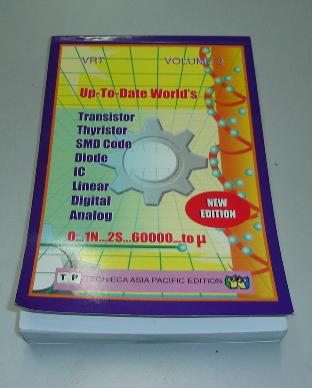
A Semiconductor Replacement Guide Searching for the right mosfet cross reference or datasheet, one has to look for a semiconductor transistor replacement data book and not the Philip ECG master replacement guide. Almost all the transistor replacement book will published out the specification of a particular components such as type of component it belong whether it is a fet, scr, bipolar transistor, horizontal output transistor and also the voltage, ampere, wattage, ohm, frequency and suggested substitution part number.
From my experienced, the substitution part number that was recommended by the data book is not always 100 % match. If you have the time, I would like to suggest to you that, find the right part number by yourself rather than depending on the transistor data book.
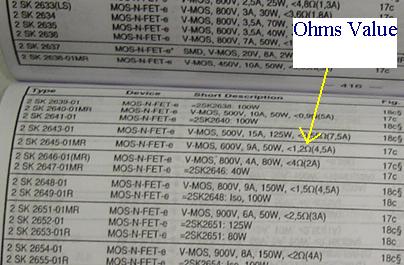
It is the same when you look for horizontal output transistor (HOT) specification which doesn't mean that the bigger specification, the better the substitution part number is. In searching for Mosfet cross reference, you have to look at the ohms value which is provided by the transistor data book besides the specification of voltage, ampere and the wattage. The replacement, besides the same or higher in voltage, ampere and wattage, one should also consider the ohms value. The ohms value has to be as close as possible.
Arrow is showing the mosfet ohms value in a transistor substituion book
If the original fet part number is 1 ohm then a good replacement mosfet must have the ohm values between of 0.5 to 1.5 ohm. Do not substitute it with a too high or too low ohms value as this will make the mosfet run warmer and eventually blow the mosfet itself. Even though you can get a replacement with a higher voltage, ampere and wattage, if the ohms value is too low or too high, the mosfet will still burnt after on for quite a while.
It runs well for sometimes before it breakdown again. After two weeks the customer brought back the printer with the same complaint which is no power. Upon checking the power side I found the same mosfet gave up again. Substituting with another mosfet part number that have a similar specification especially the ohms value solved the printer no power symptom.
Specification with larger voltage, ampere and wattage don’t guarantee that the replacement mosfet will work. So, taking the mosfet ohms value into consideration, you will have a higher chances to repaired the equipment and sometimes the replacement mosfet will also last longer.
|
|
Stereo Tool Preset Full -
However, with over 1,000 adjustable parameters (compressors, limiters, clippers, AGC, stereo image, and the infamous "Natural Dynamics"), creating a sound from scratch is a nightmare. This is why the search for a has become the holy grail for users.
But what does "full" actually mean? It isn't just a preset; it is a philosophy. A "full" preset means a configuration that leaves no dial unturned, providing loudness, clarity, bass management, and FM protection simultaneously. stereo tool preset full
In the world of digital audio processing, few names command as much respect—and as steep a learning curve—as Stereo Tool by Thimeo Audio Technology. Whether you are running an internet radio station, a pirate FM relay, an audiophile home system, or a professional broadcast chain, Stereo Tool is the gold standard for sound optimization. It isn't just a preset; it is a philosophy
In this article, we will break down what a "full" Stereo Tool preset entails, where to find the best ones, and how to load them correctly for optimal performance. A standard preset (like "Default" or "Soft Limiter") usually adjusts only the basic compressor and limiter. A "full" preset goes much deeper. Whether you are running an internet radio station,
Copyright@ 2006-2014-www.ElectronicRepairGuide.com All Rights Reserved